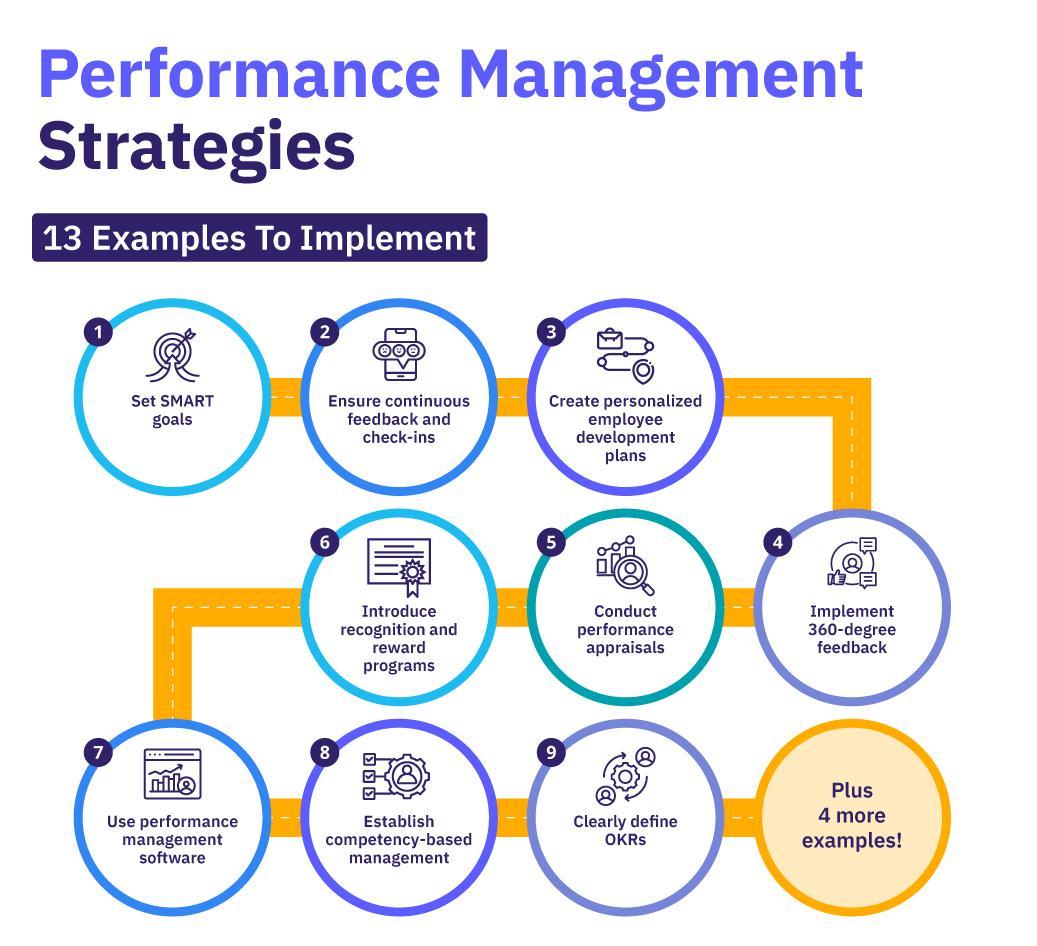
13 examples of performance management strategies
Let’s explore some popular performance management strategies examples to help guide you in developing your own strategy for your organization.
1. Set SMART goals
SMART (Specific, Measurable, Achievable, Relevant, and Time-bound) goals can facilitate clear communication with employees, clarify expectations and responsibilities, and ensure goals are realistic and achievable.
They also offer clear criteria for assessing performance, establish clear deadlines, and encourage timely task completion. This boosts employee motivation and engagement and creates a culture of continuous improvement.
2. Ensure continuous feedback and check-ins
Maintaining regular open communication with employees and offering constructive feedback can help address problems quickly and drive growth and progression.
You don’t have to schedule formal one-on-ones, however. Informal chats while on the job can help guide employees on what they’re doing well and what they should improve in their day-to-day work.
Remind managers to maintain a consistent two-way dialogue with their team. This way, employees can feel comfortable asking questions, and managers can deliver effective feedback that supports employees’ professional development.
3. Create personalized employee development plans
Personalized employee development plans recognize that each employee has unique training and development needs. Such plans allow HR and managers to connect with employees personally and shape their professional development more efficiently.
This shows employees the organization is invested in their growth and fosters a stronger employee-employer relationship, increasing employee morale and motivation.
4. Implement 360-degree feedback
360-degree feedback involves collecting feedback from an employee’s manager, supervisor, relevant stakeholders, colleagues, and any employees they manage. You can distribute an online form to respondents so they can provide feedback easily.
This will help you and the managers you work with gain a more holistic, detailed overview of an employee’s performance instead of relying on only one person’s perspective.
5. Conduct performance appraisals
Performance appraisals rely on predetermined evaluation criteria to assess each employee’s performance over a specific period (usually six months to a year). Use specific examples of performance to highlight employees’ achievements and areas for improvement.
Employees should feel comfortable speaking openly and honestly with their manager during these appraisals. HR should also coach managers to actively listen to employees’ input. Objective, unbiased performance appraisals can further employee development.
6. Introduce recognition and reward programs
Recognizing and rewarding outstanding work is an integral part of performance management. Whether they receive monetary or [non-monetary rewards, showing employees you value their efforts serves as crucial positive reinforcement.
This can boost employee motivation, performance, and retention. Don’t wait until an official performance appraisal to do this — rewarding hard work promptly is much more effective in making employees feel valued.
7. Use performance management software
Performance management software can help automate the more tedious aspects of performance management. These include updating performance review sheets, tracking performance metrics, and prompting managers to set up meetings with employees.
The right software can reduce manual, repetitive tasks and free up time to focus on other, more people-driven or strategic tasks.
8. Establish competency-based management
Competency-based management measures performance based on specific competencies, which vary between roles. It breaks up each competency into a series of relevant behaviors, which it then uses to assess the employee.
For example, the core competency “collaborates well with team” would be supported by behaviors like contributing significantly to team projects, actively listening to others’ ideas, and helping colleagues achieve shared goals.
9. Clearly define OKRs (objectives and key results)
OKRs involve the measuring of company and employee objectives through a specific set of desired results (quantitative metrics).
For example, an HR objective could be to reduce employee turnover from 15% to 5% by the end of Q4. Some key results in this case could be developing a personalized development plan for every employee and setting up a system for regular one-on-ones between managers and employees.
OKRs provide clarity and focus, turn strategic goals into plans, ensure alignment across the organization, and provide quantifiable results that make it easier to track progress.
10. Balanced scorecard
A balanced scorecard measures performance from financial, customer, internal business, and learning perspectives — which are all linked. This tool tracks the performance of different business aspects of the business, such as product/service quality, customer satisfaction, and sales numbers.
Balanced scorecards give employees a clear vision of organizational goals to improve alignment. Since a scorecard focuses on identifying the root causes of existing problems (as opposed to a single metric), improvements in specific performance areas don’t come at the expense of others.
11. Employee engagement surveys
Employee engagement surveys aim to measure engagement across the business by having employees complete anonymous questionnaires. These surveys help you better understand how your employees think, feel, and behave in the workplace.
They also facilitate feedback employees may be hesitant to share directly with managers for fear of negative repercussions. Additionally, they help employees feel heard — just remember to act on survey data to show employees their opinions truly matter.
12. Mentorship and coaching programs
Mentoring can help employees develop the skills and behaviors they need to thrive at work. Mentoring and [coaching] help foster a culture of continuous improvement, build skills and competencies that heighten productivity and innovation, and increase engagement and trust among the workforce.
13. Talent reviews and succession planning
Succession planning helps you anticipate talent gaps, identify high-potential employees who can excel in leadership roles, and deploy strategic training and development to nurture future leaders.
This aids career progression and strengthens your talent pipeline. By regularly tracking employee performance and investing in their development, organizations can boost retention and ensure they have the personnel they need to meet goals and maintain a competitive edge.