The modern performance management cycle
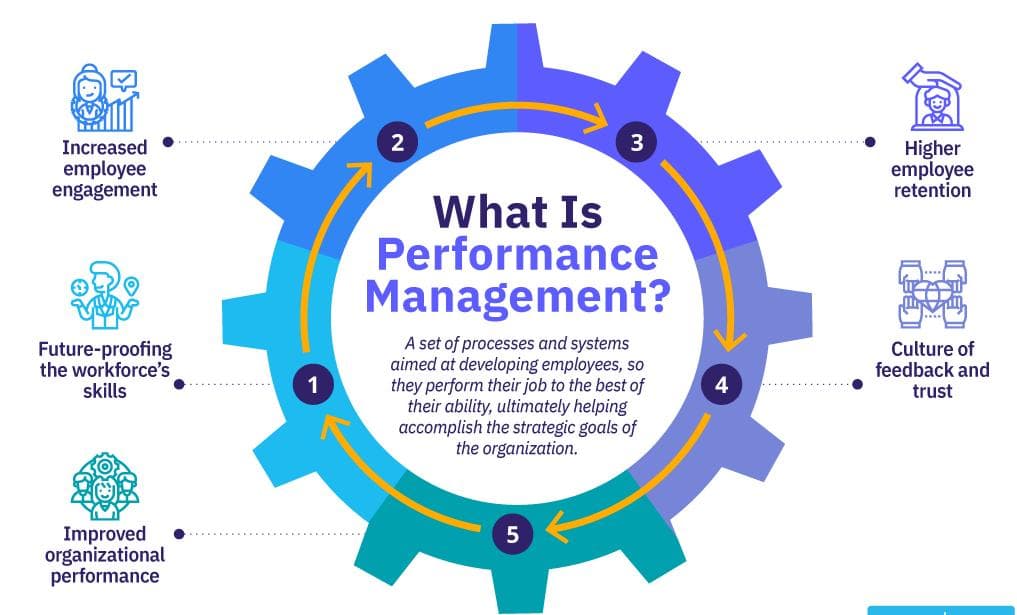
Effective performance management is a cyclical process that involves several key stages:
-
Planning and goal setting: At the start of the performance cycle, managers and employees collaborate to set clear and measurable goals. These goals should be linked to the team’s and organization’s strategic objectives, ensuring every employee understands how their work contributes to the company’s success. Using the SMART framework (Specific, Measurable, Achievable, Relevant, and Time-bound) is a best practice for defining goals.
-
Monitoring: Throughout the year, managers and employees regularly monitor progress toward the established goals. This continuous tracking, often supported by performance management software, allows for quick adjustments and helps address potential issues before they become major problems.
-
Coaching and development: Providing ongoing feedback and coaching is essential for employee growth. This stage involves regular check-ins and one-on-one meetings where managers support employees with guidance, training, and development opportunities to help them improve and reach their full potential.
-
Rating and rewarding: Performance is formally evaluated at periodic reviews, which helps to quantify an employee’s contribution to the organization. Strong performers are recognized and rewarded with incentives, promotions, or compensation adjustments. In cases of underperformance, this stage determines whether further development or other actions are necessary.
Benefits of effective performance management
When implemented correctly, performance management offers significant advantages for both employees and the organization.
For the organization:
- Increased productivity and performance: Clear goals and continuous feedback motivate employees to perform at their best, driving higher overall organizational performance.
- Improved employee engagement and retention: Employees who feel valued, receive regular feedback, and see a clear path for career progression are more engaged and less likely to leave the company.
- Strategic alignment: It ensures that individual and team goals are always aligned with the company’s broader strategic objectives.
- Informed decision-making: The data and insights collected provide a strong basis for making fair and objective decisions about compensation, promotions, and succession planning.
For employees:
- Clear expectations: Employees have a transparent understanding of their responsibilities and the metrics used to measure their success.
- Career growth: A structured process, including development plans, helps employees build new skills and see a clear path for advancement within the company.
- Timely feedback: Continuous feedback prevents surprises during formal reviews and allows employees to make corrections in real-time.
- Motivation and satisfaction: Regular recognition and appreciation for accomplishments boost morale and job satisfaction.
The shift from traditional to continuous performance management
Over the past decade, many organizations have moved away from the traditional, once-a-year performance appraisal in favor of a more flexible and continuous approach.
| Traditional performance appraisal | Continuous performance management (CPM) | |
|---|---|---|
| Frequency | Typically an annual or semi-annual event. | Ongoing, with frequent check-ins and feedback sessions. |
| Purpose | Evaluative, focused on past performance, and often tied directly to compensation. | Developmental, focused on present and future growth, and often separates pay from reviews. |
| Approach | Formal and often a top-down evaluation by a manager. | Collaborative, interactive, and fosters a coaching culture. |
| Outcomes | Ratings, documentation, and administrative decisions. | Continuous improvement, higher engagement, and agility. |
This evolution is largely driven by the recognition that an agile, data-informed approach provides more timely feedback and better supports employee and organizational growth.