 Remote Employee Management: Building Productivity Beyond the Office
Introduction
The modern workplace has evolved — flexibility, autonomy, and connectivity now define success. As remote work becomes a permanent fixture, managing dispersed teams requires more than just digital tools — it demands trust, structure, and data-driven HR practices.
An HRMS (Human Resource Management System) bridges this gap by transforming how organizations track performance, foster engagement, and ensure accountability for remote teams.

 1. Understanding Remote Employee Management
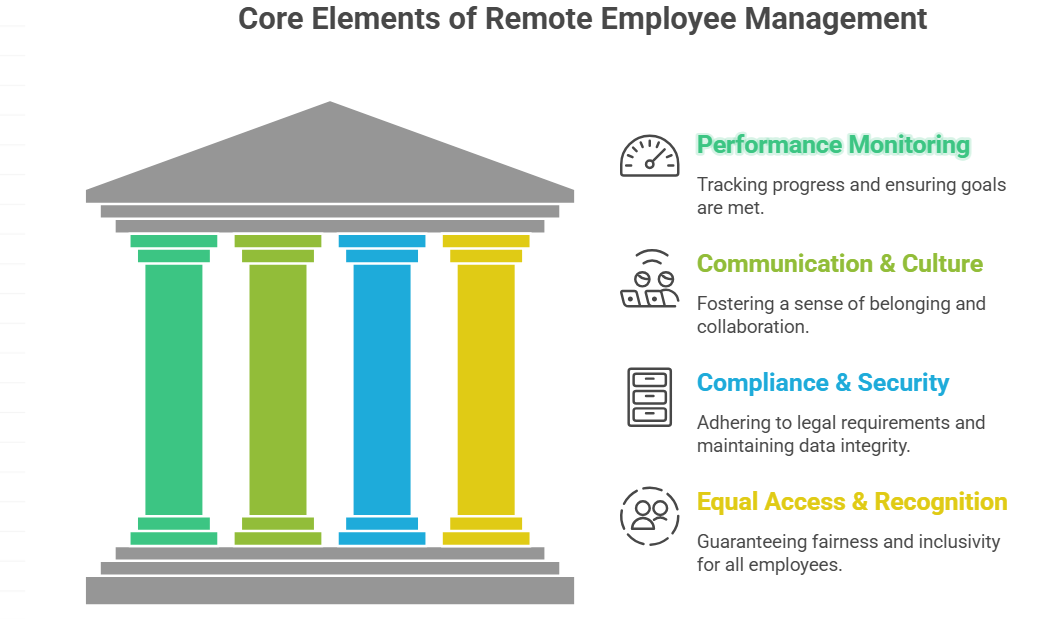
Remote Employee Management is the strategic process of supervising, supporting, and evaluating employees working from outside a traditional office environment. It involves:
- Monitoring performance and productivity.
- Maintaining communication and culture.
- Ensuring compliance, security, and timely payroll.
- Providing equal access to resources and recognition.
 2. Challenges in Managing Remote Employees
| Challenge | Impact | Example |
|---|---|---|
| Lack of visibility | Difficulty in tracking productivity | Managers can’t see real-time task progress |
| Communication gaps | Misalignment and reduced collaboration | Missed updates due to fragmented tools |
| Compliance complexity | Risks in attendance, data, and policies | Different local labor laws for remote hires |
| Employee disengagement | Lower morale and loyalty | Feeling disconnected from company culture |
| Inconsistent performance data | Unfair evaluations | Bias towards visible/in-office employees |
 3. How HRMS Solves Remote Management Challenges
An HRMS like greytHR provides a unified solution for remote workforce oversight through automation, transparency, and real-time data.
| HRMS Capability | Remote Work Benefit |
|---|---|
| Geo Attendance & Remote Login | Track time and attendance from any location using GPS or mobile apps. |
| Cloud-Based Payroll | Process salaries for employees across cities or countries with compliance automation. |
| Performance Management | Monitor KPIs and run digital performance reviews seamlessly. |
| Employee Self-Service Portal (ESS) | Empower employees to update info, request leave, or access payslips without HR intervention. |
| Digital Onboarding | Smoothly integrate new hires remotely with e-forms and virtual checklists. |
| Communication & Announcements | Use in-app messages or notifications to keep teams aligned. |
| Task Tracking & Workflow Automation | Simplify project approvals and task escalations remotely. |
 4. Best Practices for Remote Employee Management
- Set Clear Expectations
Define measurable goals, deadlines, and success metrics for each role.
2.Example:* Weekly performance dashboards in greytHR. - Enable Transparent Communication
Integrate HRMS notifications, chatbots (like Bella), and calendar alerts to reduce dependency on scattered tools. - Encourage Accountability with Data
Use attendance logs, task completions, and activity reports to assess outcomes fairly. - Prioritize Employee Well-being
Conduct wellness check-ins, survey morale, and recognize achievements virtually. - Ensure Security and Compliance
Implement secure logins, encrypted data storage, and location-based compliance tracking. - Use Recognition Programs
Celebrate top performers and referrers in community newsletters or leaderboards.
 5. HRMS-Driven Remote Management Workflow
Step 1: Employee logs in remotely via mobile or web.
Step 2: Attendance and productivity tracked automatically.
Step 3: HRMS syncs data with payroll and performance dashboards.
Step 4: Managers receive automated insights on deliverables and time efficiency.
Step 5: HR reviews reports for engagement and compliance gaps.
Result: Seamless visibility into workforce health and output — without micromanagement.
 6. Key Metrics to Measure Remote Workforce Success
| Category | Metric | Goal |
|---|---|---|
| Productivity | Task completion rate, turnaround time | >90% weekly completion |
| Engagement | Participation in meetings, surveys | 70–80% active response |
| Attendance | Login compliance, absenteeism trends | <5% unplanned absence |
| Performance | KPI achievement, project contribution | Aligned to OKRs |
| Retention | Attrition % and exit feedback | <10% voluntary exits |
 7. The greytHR Advantage in Remote HR
| Feature | Outcome |
|---|---|
| Geo-tagged Attendance | Accurate, location-based check-ins for remote teams. |
| Mobile ESS App | Employees manage their HR activities on the go. |
| Automated Payroll | 100% error-free disbursements across locations. |
| Workflow Engine | Seamless approvals and document management. |
| Integration Ready | Connects with collaboration tools like Teams or Slack. |